
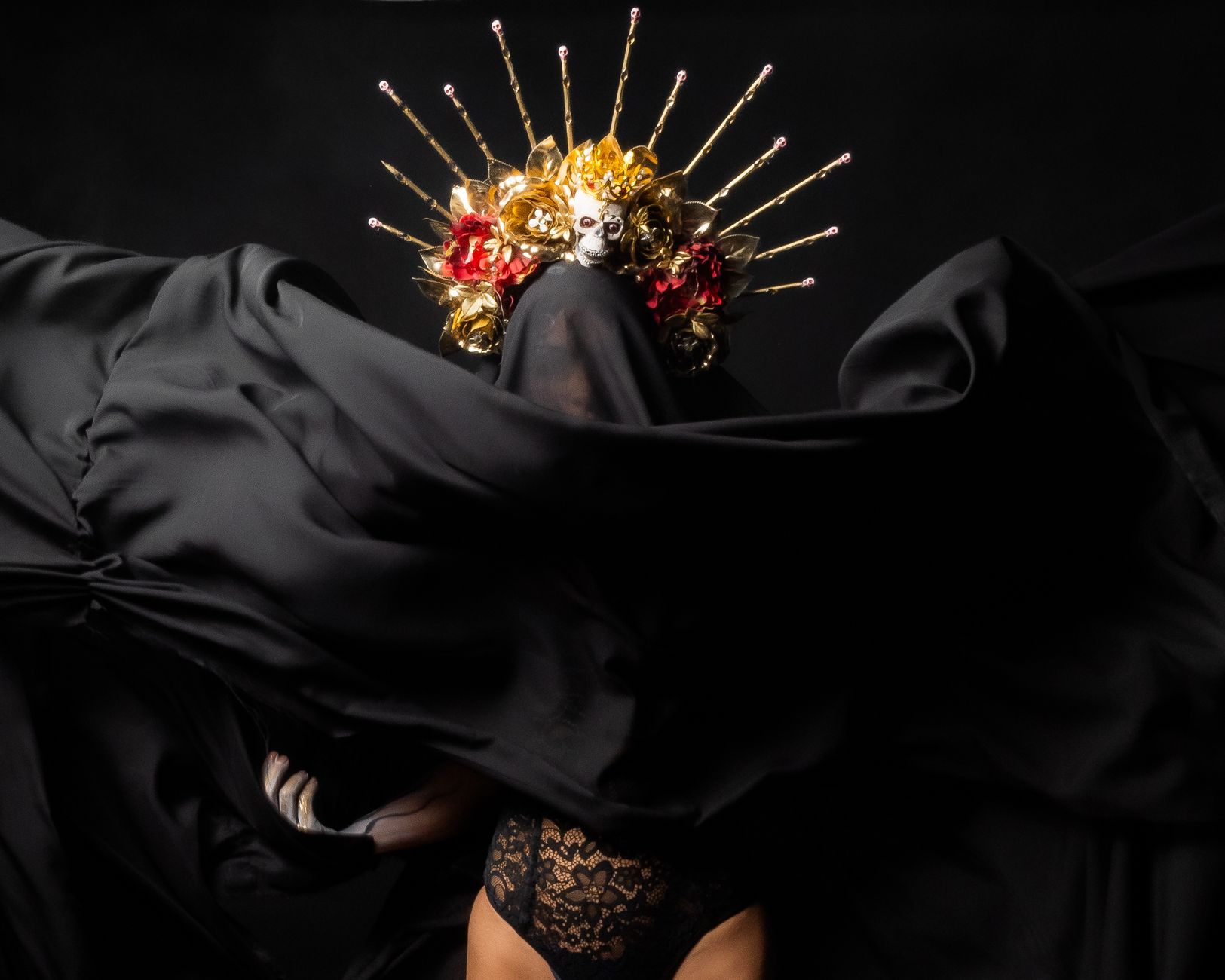
The "villain era" started as a pop culture phrase, a way for people to say they were done being agreeable and ready to do things for themselves. It spread fast through social media, and now it's reached the cutting table. Villain era fabric prints are one of the most requested custom fabric categories right now, pulling in sewists who want something darker, moodier, and more dramatically satisfying than the soft pastels and ditsy florals that dominated the years before. The aesthetic borrows heavily from gothic illustration, fantasy film, and the kind of costume design that belongs to the character everyone secretly roots for.
What villain era prints actually look like
The defining qualities are contrast and intent. These prints don't do gentle. Deep jewel tones sit alongside near-black backgrounds: oxblood, midnight navy, poisoned green, bruised violet. The motifs themselves tend to be theatrical: ravens, thorned roses, crescent moons, poisoned apples, serpents, and broken hourglasses. Some designs lean into maximalist layering, with motifs stacked densely across the fabric in a way that feels almost overwhelming at small scale but resolves into something striking when cut and sewn.
Others take a more graphic approach, using bold isolated motifs on dark grounds. Think a single black rose centred on deep charcoal, or a repeating serpent pattern rendered in iridescent teal on black. The appeal is the same either way: a fabric that reads as a statement before a single seam is sewn.
It's worth noting how different this is from the botanical fabric prints trend that built momentum over recent years. Botanicals were lush and detailed, yes, but generally warm and nature-forward. Villain era takes the same density of illustration and redirects it toward the sinister and theatrical.
Who's buying villain era prints
The customers ordering these fabrics tend to fall into two distinct groups. The first is the costume and cosplay sewing community, who've always had a strong appetite for dramatic, character-driven prints. The second is a broader group of home sewists who want their everyday makes, pouches, bags, book sleeves, clothing, and accessories, to carry more personality than mainstream fabric ranges tend to offer. Both groups are increasingly turning to custom digital printed fabric because mainstream fabric retailers rarely stock anything this specific.
The age range is wider than you'd expect. Villain era aesthetics resonate strongly with younger sewists, but the gothic and dark maximalist end of the spectrum also pulls in experienced makers who've been seeking this kind of print for years and simply couldn't find it before custom printing became accessible.
Why digital printing is perfect for this trend
Villain era prints are almost impossible to produce well through traditional screen printing. The colour depth required, particularly the near-black backgrounds with fine-detail motifs, demands a printing process that can handle subtle tonal shifts without muddying the design. Digital fabric printing handles this with precision: ink is laid down directly from a file, so a poisoned-apple print with 12 colour values in the shadow detail reproduces exactly as the designer intended.
The other advantage is minimum order flexibility. A traditional mill producing a gothic serpent print at scale is an enormous financial commitment for any small business. Digital printing through a service like Fabric by TrishaMakes lets sewists order exactly the quantity they need, whether that's a single panel for a book sleeve or several metres for a costume commission.
How to use villain era prints in your makes
The natural instinct is to match dark prints with dark everything, but that's not always where these fabrics shine. A few approaches worth trying:
- Contrast lining: Use the villain era print as the lining of a bag or pouch with a plain exterior. The reveal when the bag opens becomes the whole point.
- Feature panels: Cut the print into a centred panel on a garment front or pocket, rather than using it across the full piece. This works especially well with large isolated motifs.
- Coordinated accessories: A set of zipper pouches in villain era prints sells brilliantly at markets precisely because the aesthetic is so cohesive. Dark florals, moons, and serpents as a coordinated range feel curated rather than chaotic.
For sewists thinking about selling their makes, these prints are particularly strong performers. The niche is specific enough that buyers who want this aesthetic seek it out actively, and there's limited competition from mass-market makers who tend to avoid dark palettes. If you're exploring which makes sell best, gaming inspired fabric designs follow a similar logic: a devoted audience, a print language that mass retail ignores, and strong demand from custom preorder customers.
The palettes driving villain era design right now
The most requested colourways in this space cluster around a few specific combinations. Oxblood and antique gold reads as gothic royalty and works across both costume and everyday makes. Midnight black with iridescent or holographic accents is extremely popular in the cosplay community, where the in-person shimmer reads beautifully under event lighting. Deep forest green with black and copper sits at the intersection of villain era and dark cottagecore, appealing to sewists who want something dramatic but not aggressively gothic.
What these palettes share is deliberate restraint in the accent colours. The backgrounds carry the mood, and the highlights do the work of making the print feel luxurious rather than flat. A well-designed villain era fabric feels expensive to look at, and that quality translates directly into perceived value in finished makes.
Where the trend is heading
The villain era aesthetic shows no signs of retreating. If anything, it's absorbing adjacent influences and expanding. Dark academia motifs are being incorporated alongside the original gothic imagery. Fantasy and dark fairy tale references, think thorn-wrapped architecture and shadowed forest canopies, are appearing with increasing frequency in preorder requests. The anti-hero arc in popular fiction continues to produce new visual reference points that feed back into surface pattern design.
For makers and small businesses, the practical takeaway is simple. Customers who want this print language exist in real numbers, they spend deliberately on fabric that matches their aesthetic, and they return when they find a supplier who understands what they're looking for. Villain era prints aren't a passing novelty. They're filling a gap that softer, safer print ranges left open.